
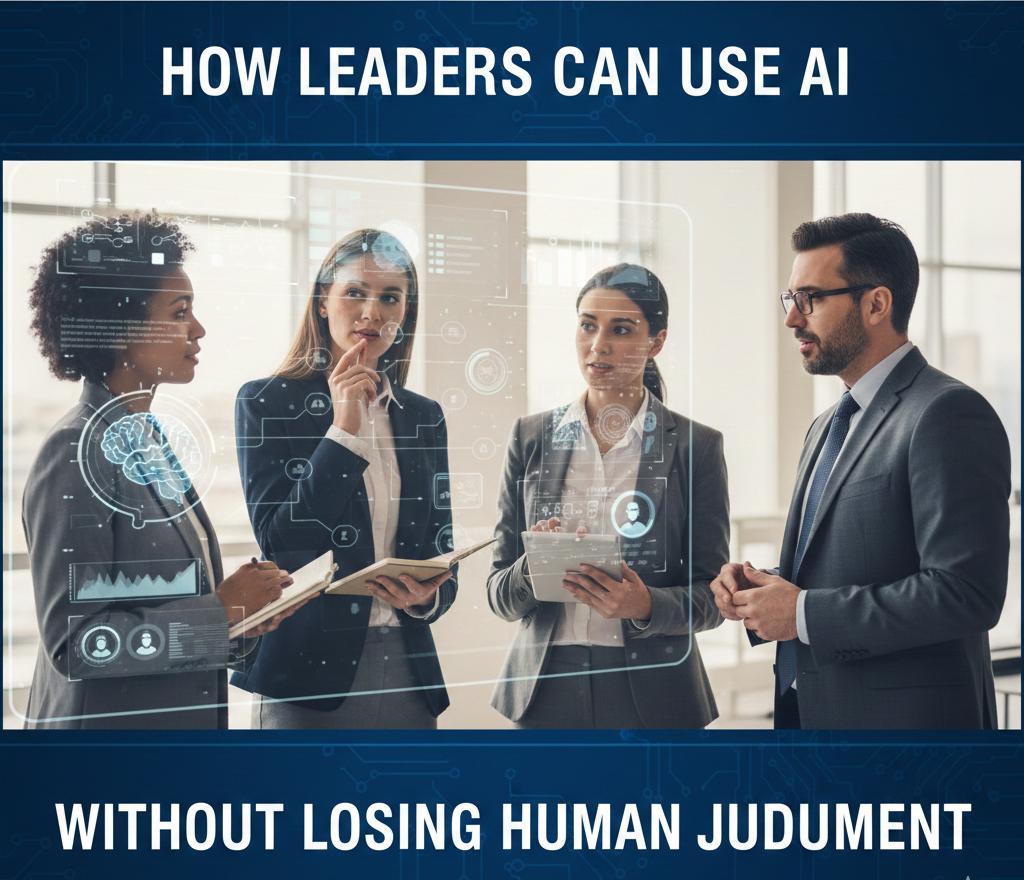
What if AI could make you sharper, faster, and wiser, but never replace your voice?
That is the real question facing CEOs, founders, CTOs, HR heads, and board members across the United States. AI tools now sit inside strategy rooms. They draft reports. They scan risks. They predict trends. Yet leaders still fear one thing.
Will we lose our human judgment?
The truth is simple. AI is a tool. Judgment is a skill. The best leaders blend both.
In this guide, we break down what is AI leadership, how to use AI in leadership, and how AI is changing leadership in ways that demand courage and care.
What Is AI Leadership?
Let us start with the basics. What is AI leadership?
AI leadership means using artificial intelligence to support better decisions, faster insight, and stronger growth while humans remain in control.
It does not mean letting machines decide your strategy. It means using AI to see more clearly.
Strong AI leaders:
• Ask better questions
• Seek data before guesswork
• Move fast but think deep
• Protect ethics and trust
This is how AI is redefining leadership today.
How AI Is Changing Leadership at the Executive Level
How is AI redefining leadership in real life?
In the past, leaders waited for reports. They relied on teams to gather data. Decisions moved slow.
Now AI can:
• Scan huge data sets in seconds
• Spot patterns no human can see
• Draft board briefs
• Simulate market moves
• Flag risk early
Here is a simple view of the shift.
Decision Area | Old Way | AI Enhanced Way
Data Review | Static reports | Real time dashboards
Risk Scan | Manual checks | Pattern alerts
Content Draft | Team heavy | AI plus edit
Scenario Test | Costly pilots | Fast simulations
Market Trends | After the fact | Predictive
This change does not remove leaders. It pushes them to think at a higher level.
How to Use AI in Leadership Without Losing Human Judgment
Many executives ask how to use AI in leadership without losing control.
The answer is balance.
First, use AI for research. Let it scan trends and data.
Second, use AI for drafts. Let it outline plans and memos.
Third, review every output. Add your values, tone, and insight.
Fourth, make the final call yourself.
Human judgment rests on ethics, empathy, and experience. AI cannot replace that.
When teams see leaders owning decisions, trust grows.
How to Create Thought Leadership Content with AI
Thought leadership builds brand power. It shapes markets. It wins trust.
So how to create thought leadership content with AI in a way that feels real?
Start with your bold view. What do you see in your industry that others ignore?
Ask AI to scan reports and trends. Let it gather proof.
Use AI to draft an outline or first version.
Then refine. Add your stories. Add hard lessons. Add clear stands.
This is how to ensure thought leadership in AI responses. AI can draft. You must lead.
Content strategists, LinkedIn creators, and AI product leaders should treat AI as a writing partner, not the final voice.
If you are new to digital strategy, you may also want to read what is social media to understand how thought leadership spreads in today’s world.
How to Ensure Thought Leadership in AI Responses
AI answers can sound bland if you let them.
To ensure strong impact, use this test.
Is the idea bold?
Is the insight fresh?
Is the tone firm?
Is the proof clear?
Push AI for depth. Ask for case studies. Ask for risks and trade offs.
Then rewrite with your voice.
That is how forward thinking firms protect brand strength.
How to Present AI Knowledge Platform Benefits to Company Leadership
CIOs and CDOs often struggle with how to present AI knowledge platform benefits to company leadership.
Boards care about return on investment. They care about risk. They care about growth.
Frame your case around four pillars.
Cost Savings
Show how AI reduces manual work.
Speed
Show how AI shortens time to insight.
Risk Control
Show how AI flags fraud and bias.
Growth
Show how AI opens new revenue streams.
Here is a simple value chart.
Benefit Area | Executive Impact
Admin Cost | Lower overhead
Decision Speed | Faster action
Error Rate | Fewer mistakes
Market Reach | Stronger brand
Tie each benefit to a KPI. Speak in clear language. Keep it short.
If you also build digital presence, explore how social media affects mental health to understand how communication tools shape culture and leadership tone.
How Do AI Conversation Bots Compare in Market Leadership?
Customer trust drives revenue. Many firms now deploy AI chat tools.
So how do AI conversation bots compare in market leadership?
Basic bots follow scripts. They answer fixed questions.
Advanced AI bots understand context. They adapt tone. They learn over time.
Feature | Basic Bot | Advanced AI Bot
Context Memory | Low | High
Tone | Robotic | Natural
Learning | Static | Adaptive
Insight | Minimal | Deep
Firms that use advanced bots often improve support speed and user trust.
Yet governance matters. Leaders must review bot outputs and protect brand tone.
Is It Best AI Driven Roleplays for Leadership Training?
Learning and development heads often ask, is it best AI driven roleplays for leadership training?
AI roleplay tools simulate tough talks. They let leaders practice crisis response. They test sales pushback.
Benefits include:
• Safe space to practice
• Fast feedback
• Repeat learning
But AI should not replace human coaching.
The best path blends AI drills with live mentor review.
That mix builds skill and empathy.
What Are the Ethical Considerations of Using AI in Leadership?
Power demands care.
What are the ethical considerations of using AI in leadership?
Bias
AI can reflect unfair past data. Leaders must test and adjust.
Privacy
Protect staff and client data at all times.
Transparency
Be open when AI shapes reports or insights.
Accountability
Leaders must own all final decisions.
Ethics officers and AI governance teams should work close with engineering leaders and product managers.
Trust is your true edge.
How AI Is Changing Executive Decision Models
Executive models once moved slow and straight.
Now they move fast and in loops.
Leaders test ideas. They adjust. They refine. They watch live data.
This dynamic model rewards those who learn fast.
It also demands strong judgment.
AI shows options. Humans choose.
Building a Culture That Balances AI and Judgment
Forward thinking companies build culture around clear values.
Train teams on AI use.
Set ethical standards.
Encourage open questions.
Reward human insight.
When staff feel safe to question AI outputs, your firm grows stronger.
If you want to see how messaging spreads in modern markets, review social media press release examples that worked.
Strong communication supports strong leadership.
FAQ
What is AI leadership?
AI leadership is the ability to use AI tools to improve decisions and growth while humans stay responsible for final choices.
How is AI redefining leadership today?
AI speeds up insight, improves risk checks, and helps leaders test ideas before full launch.
How to use AI in leadership wisely?
Use AI for research and drafts. Review outputs for bias and tone. Keep final calls human.
How to create thought leadership content with AI?
Start with a bold point of view, use AI to gather research, then refine with your own stories and proof.
How to ensure thought leadership in AI responses?
Push for fresh insight, clear proof, and strong tone. Edit carefully to match your brand voice.
How to present AI knowledge platform benefits to company leadership?
Focus on cost savings, speed, risk control, and growth. Link each to a clear business KPI.
How do AI conversation bots compare in market leadership?
Advanced bots adapt and learn, offering better support and brand alignment than basic script bots.
Is it best AI driven roleplays for leadership training?
They work well for safe practice and fast feedback, but should be paired with human coaching.
What are the ethical considerations of using AI in leadership?
Leaders must guard against bias, protect privacy, stay transparent, and remain accountable.
The Final Word
AI is not the enemy of human judgment.
It is a tool. A powerful one.
The leaders who win in the United States market will not reject AI. They will shape it. They will blend data with wisdom. Speed with empathy. Insight with ethics.