
AI is moving fast across the United States.
However, speed alone does not build strong leadership.
Last year, a large U.S. company paused its AI hiring tool just days before launch.
The system worked well. Yet early testing revealed bias.
Because fairness matters, the CEO stopped the rollout.
Instead of chasing speed, he protected trust.
That decision shows what real AI leadership looks like.
Today, CEOs, CTOs, founders, HR heads, and board members face the same challenge.
On one hand, AI boosts growth.
On the other hand, it increases ethical risk.
Therefore, leaders must balance innovation with responsibility.
What Is AI Leadership?
First, what is AI leadership?
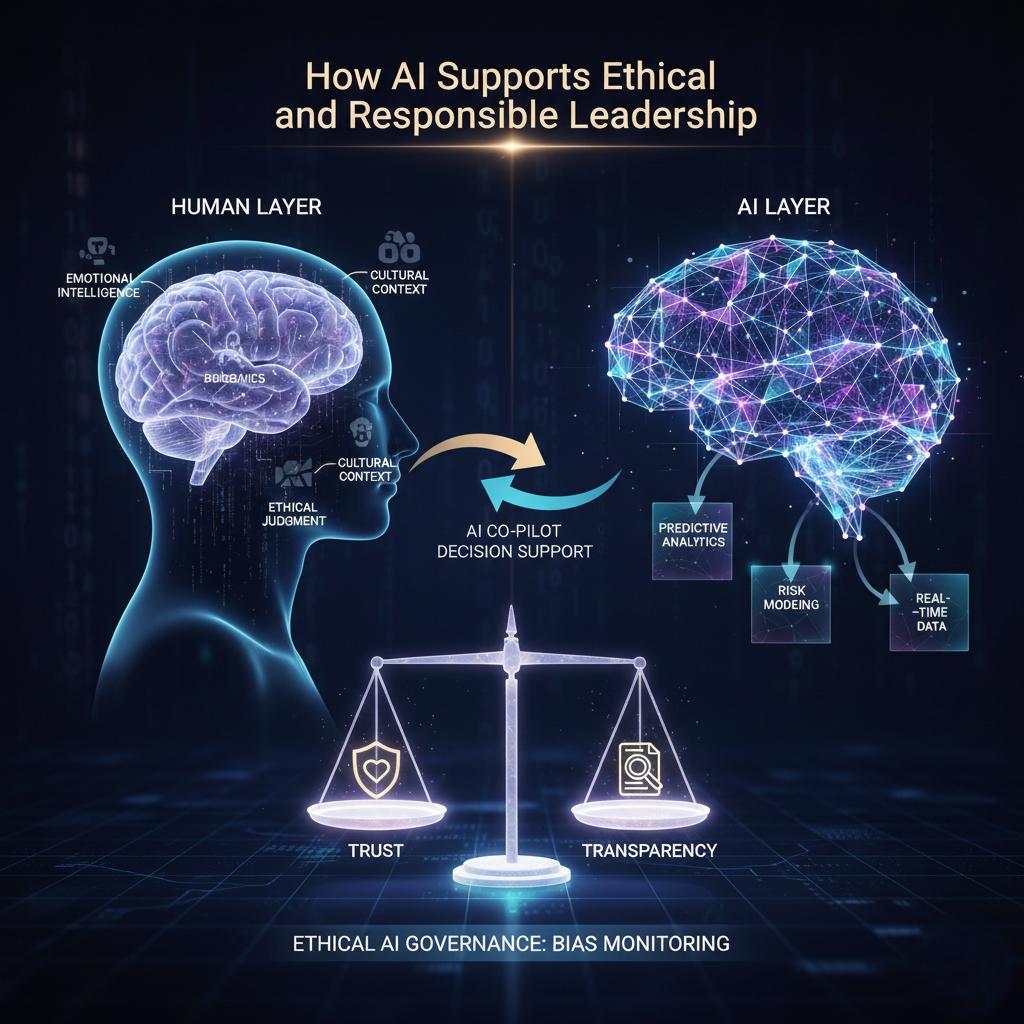
Simply put, AI leadership means using artificial intelligence to improve decisions while keeping human judgment in control.
In other words, AI supports leaders. It does not replace them.
Strong AI leaders study data carefully.
At the same time, they protect privacy.
Moreover, they remove bias before harm spreads.
Above all, they take responsibility for outcomes.
If you want deeper insight into this shift, read:
https://alltipsmedia.com/ai-and-leadership-evolution-what-every-executive-should-know/
How AI Is Changing Leadership
Now let us examine how AI is changing leadership.
In the past, executives waited weeks for reports.
Today, dashboards update instantly.
As a result, leaders make faster decisions.
Previously, strategy was reactive.
Now, it is predictive.
For example, AI models forecast revenue trends, employee churn, and market demand.
According to McKinsey, companies that adopt AI at scale can increase revenue by up to 20 percent in certain business units.
Source: https://www.mckinsey.com/capabilities/quantumblack/our-insights/the-state-of-ai-in-2023
Because of these gains, AI adoption keeps rising.
However, growth without ethical controls can damage long-term brand value.
Therefore, responsible AI leadership becomes essential.
How Is AI Redefining Leadership?
So, how is AI redefining leadership?
First, it shifts authority toward data-driven insight.
Second, it increases transparency across teams.
Third, it demands digital fluency from executives.
Today, investors ask about AI roadmaps during earnings calls.
Meanwhile, regulators examine AI risk frameworks.
As a result, leadership now includes AI literacy.
Leaders must understand how models work.
They must question outputs.
They must set clear guardrails.
How to Use AI in Leadership Safely
Many executives worry about losing the human element.
That concern is valid.
So how to use AI in leadership the right way?
Keep humans in the loop.
Use AI to analyze trends.
Use AI to test scenarios.
Use AI to identify risk.
However, keep final decisions human.
A practical model works best:
Define the business goal clearly.
Then gather clean and fair data.
Next, run AI tools.
After that, review insights with experts.
Finally, make the decision as a leadership team.
For practical guidance on strengthening leadership communication with AI, read:
https://alltipsmedia.com/using-ai-to-strengthen-leadership-communication-and-influence/
Real Example: Responsible AI in Hiring
Consider a real case.
A U.S. technology firm used AI to screen job applications.
Hiring speed improved by 40 percent.
However, HR leaders detected gender bias in early results.
Because fairness mattered, the company paused deployment.
Then they retrained the model using balanced data.
In addition, they added human review checkpoints.
As a result, hiring remained fast and became more fair.
That is responsible leadership in action.
What Are the Ethical Considerations of Using AI in Leadership?
Now we address the core question.
What are the ethical considerations of using AI in leadership?
First, bias presents serious risk.
If data reflects past inequality, AI may repeat it.
Second, privacy must remain protected.
Since AI systems process sensitive information, security cannot be optional.
Third, transparency builds trust.
When AI influences decisions, leaders must explain how it works.
Fourth, accountability must be clear.
If errors occur, responsibility must not be vague.
Finally, over-monitoring damages culture.
Because employees value dignity, leaders must avoid excessive tracking.
In short, ethics protects long-term success.
How to Create Thought Leadership Content With AI
Executives also ask how to create thought leadership content with AI without losing authenticity.
AI can analyze trends quickly.
It can suggest structured outlines.
It can improve clarity and grammar.
However, AI alone cannot create authority.
Therefore, leaders must add real experience.
Share company data.
Include case studies.
Take clear positions.
For deeper strategy, explore:
https://alltipsmedia.com/thought-leadership-in-the-age-of-artificial-intelligence/
How to Ensure Thought Leadership in AI Responses
AI tools generate fast answers.
Yet speed does not equal influence.
So how to ensure thought leadership in AI responses?
Add expert insight.
Insert verified data.
Remove vague language.
Refine tone carefully.
In other words, AI drafts the base. Leaders refine the message.
How to Present AI Knowledge Platform Benefits to Company Leadership
If you pitch AI internally, focus on measurable results.
When thinking about how to present AI knowledge platform benefits to company leadership, speak clearly in numbers.
For example:
Manual compliance review takes 15 hours weekly.
AI-assisted review takes 4 hours weekly.
Therefore, the team saves 11 hours each week.
Translate time into cost savings.
In addition, show risk reduction.
Above all, show competitive advantage.
Executives respond to ROI, not hype.
How Do AI Conversation Bots Compare in Market Leadership?
AI conversation bots compete heavily today.
So how do AI conversation bots compare in market leadership?
Look at accuracy first.
Then review data security standards.
Next, check integration with enterprise systems.
After that, evaluate bias testing controls.
Finally, assess scalability.
Choose tools that solve real business problems.
Avoid tools built only for buzz.
Is It Best AI Driven Roleplays for Leadership Training?
Many HR and learning teams ask: is it best AI driven roleplays for leadership training?
In many cases, yes.
AI simulations allow leaders to practice crisis talks.
They also help rehearse negotiations and feedback sessions.
Moreover, they scale across large teams.
However, combine AI simulations with live coaching.
That blend produces deeper growth.
Quick Leadership Comparison
Without ethical AI:
Hidden bias grows.
Legal risk increases.
Employee trust declines.
Brand value weakens.
With responsible AI leadership:
Policies guide action.
Bias testing protects fairness.
Data security strengthens trust.
Long-term value grows.
The difference is clear.
FAQ
What is AI leadership?
AI leadership means using AI tools to guide strategy while keeping human judgment strong.
How is AI redefining leadership?
It shifts leadership toward data-driven and predictive decision-making.
How to use AI in leadership responsibly?
Keep humans involved, audit for bias, protect privacy, and ensure accountability.
What are the ethical considerations of using AI in leadership?
Leaders must manage bias, transparency, privacy, and over-monitoring risks.
Is AI driven roleplay effective?
Yes. It provides scalable leadership practice when combined with human coaching.
Final Thoughts
AI will shape every major industry.
However, technology alone does not define success.
Instead, leadership determines the outcome.
You can innovate boldly.
At the same time, you can protect trust.
Therefore, the strongest executives combine data power with ethical discipline.
If you want proven frameworks, practical guidance, and executive-ready AI leadership strategies, explore our AI leadership resources on AllTipsMedia.
Lead with clarity.
Lead with courage.
Most importantly, lead with responsibility.